
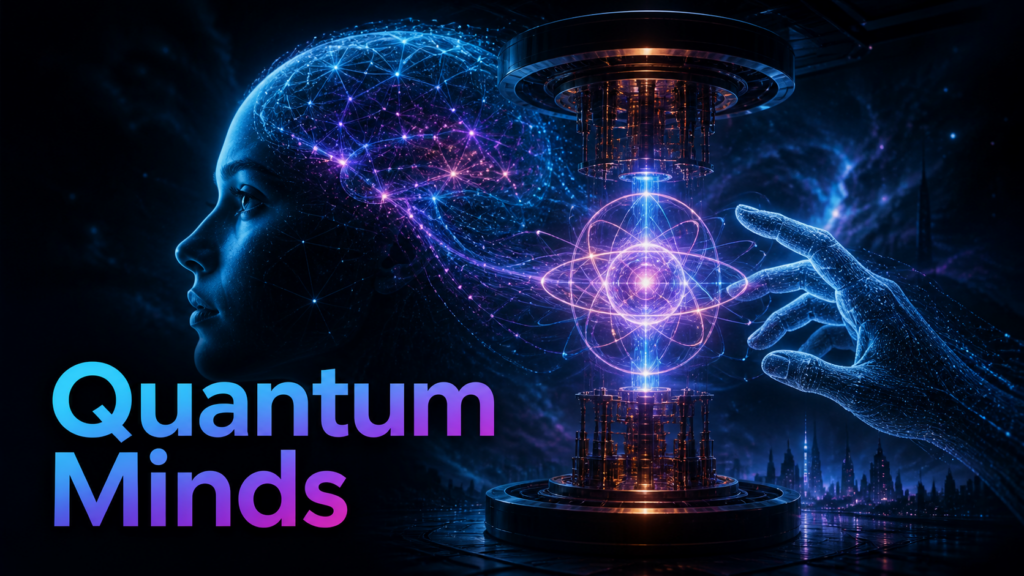
The next great shift in artificial intelligence may not arrive as a louder chatbot, a faster image generator, or a more persuasive voice assistant. It may begin more quietly, inside machines that do not think in the familiar rhythm of ones and zeroes. These machines will not simply calculate more quickly in the ordinary sense. They will explore possibility differently, moving through certain classes of problems as though the landscape itself had been folded, allowing distant paths to touch.
Quantum computing is often described with metaphors that feel almost mystical: particles in many states at once, hidden correlations across distance, answers emerging from clouds of probability. The poetry is tempting, but the practical meaning is more grounded. A quantum computer uses the behavior of matter at its smallest scales to process information in ways classical computers cannot efficiently imitate. If such systems become reliable enough to pair with advanced AI, the result could be less like adding a bigger engine to today’s digital world and more like giving artificial intelligence a new kind of intuition for complexity.
That possibility deserves careful attention. Not because quantum machines will make AI magical, conscious, or omniscient. They will not. But because many of the hardest questions humans ask machines to help solve are not neat. They involve uncertainty, competing goals, molecular interactions, financial risk, climate dynamics, logistics, cryptography, and the tangled behavior of systems with too many variables for ordinary computation to comfortably hold. AI is already good at recognizing patterns in data. Quantum computing could help it search, simulate, and optimize within worlds where the patterns are hidden beneath layers of probability.
Why today’s AI still runs into walls
Modern AI has become astonishingly capable by learning from data at enormous scale. It can predict words, detect tumors in scans, translate languages, design images, help write software, and notice signals that people might miss. Beneath these achievements is a familiar computational foundation: classical processors moving electrical states through circuits, storing information as bits, and performing immense numbers of operations with relentless speed. The scale is breathtaking, yet the underlying logic remains fundamentally binary.
This foundation is powerful enough for much of what society needs. The internet, weather forecasting, global finance, scientific modeling, and today’s generative AI all stand on classical computation. But there are categories of problems where adding more conventional power gives diminishing returns. Some problems grow so rapidly in complexity that even vast data centers struggle. The issue is not laziness, poor engineering, or lack of imagination; it is the shape of the problem itself.
Consider drug discovery. A useful medicine often depends on the behavior of molecules whose electrons interact according to quantum rules. Classical computers can approximate these interactions, but the approximations become difficult as systems grow. Or consider an airline trying to schedule crews, aircraft, gates, maintenance windows, passenger connections, fuel constraints, and weather disruptions at once. Every new variable multiplies the field of possibilities. AI can help guide the search, but the search space can become a maze with more corridors than any ordinary machine can walk in time.
In practice, AI often succeeds by learning shortcuts. It does not calculate every possible future; it builds models that guess which futures matter. This is useful, and often brilliant. Yet when the smallest differences can change outcomes, or when the system being modeled is inherently quantum, those shortcuts can blur what matters most. Practical quantum computing could offer AI a different kind of instrument, not replacing the learned shortcut but giving it a deeper way to probe certain terrains.
What a quantum computer actually changes
A classical bit is like a switch: off or on, zero or one. A quantum bit, or qubit, can exist in a state described as a combination of zero and one until it is measured. This does not mean it simply stores two ordinary values at once in a magical memory drawer. It means its state follows the mathematics of quantum probability, and multiple qubits can form patterns of possibility that evolve together.
The crucial idea is not just superposition but interference. Quantum algorithms are designed so that wrong paths tend to cancel out while useful paths become more likely to appear when the system is measured. This is delicate. It is less like asking every possible question simultaneously and more like choreographing waves so that the answer has a better chance of rising from the surface. If the choreography is right, some problems can be approached far more efficiently than they can be with ordinary computation.
Entanglement adds another layer. When qubits are entangled, the state of each cannot be fully described alone; the meaningful information lives in the relationship between them. For AI, this is an intriguing analogy because intelligence also depends heavily on relationships: between words in a sentence, genes in a cell, components in an economy, intentions in a conversation. Quantum entanglement is not the same as semantic meaning, but it offers a computational language naturally suited to certain kinds of interdependence.
Still, the word practical matters. Today’s quantum computers are fragile. Qubits are easily disturbed by heat, vibration, electromagnetic noise, and nearly any interaction with the outside world. Current devices are noisy and limited, and many require extreme conditions to operate. The leap from laboratory demonstrations to broadly useful systems requires error correction, better hardware, improved algorithms, and integration with classical infrastructure. The future being imagined here is not a fantasy switch that turns on tomorrow. It is a gradual joining of two imperfect but rapidly evolving toolkits.
Hybrid intelligence, not replacement
The most realistic future is not AI living inside a quantum computer. It is hybrid intelligence: classical AI systems using quantum processors as specialized accelerators for certain tasks. A useful comparison is the graphics processing unit. GPUs did not replace general computing, but they transformed AI because they were exceptionally good at the matrix operations behind deep learning. Quantum processors may play a similarly targeted role, though for different mathematical structures.
In such a hybrid system, an AI model might identify a promising problem, translate part of it into a form suitable for a quantum processor, receive probabilistic results, and then interpret those results through classical reasoning. The relationship would be iterative. The AI could learn which quantum routines help, when to trust them, when noise is distorting the answer, and how to combine incomplete signals with other evidence.
This pairing could also make quantum computers easier to use. Programming a quantum device is not intuitive for most people, and even experts must think carefully about hardware constraints. AI could become an interface between human intent and quantum procedure, helping formulate problems, choose algorithms, tune circuits, and explain outcomes. Instead of requiring every scientist, engineer, or planner to become a quantum specialist, an AI companion could translate ordinary goals into computational experiments.
The result would not be a single supermind. It would be a layered system of strengths. Humans would bring purpose, judgment, ethics, lived experience, and the ability to ask why a problem matters. Classical AI would bring pattern recognition, language, data integration, and adaptive modeling. Quantum processors would bring specialized access to certain forms of complexity. The art would lie in orchestration.
Discovery at molecular scale
One of the most compelling possibilities lies in science itself. Nature is quantum before it is biological, chemical, or technological. The properties of materials, the behavior of catalysts, the folding of proteins, and the flow of energy through molecules all emerge from quantum interactions. When scientists simulate these systems classically, they often rely on approximations. Many approximations are excellent, but some questions remain stubbornly difficult because the underlying reality refuses to flatten into simple terms.
An AI paired with a practical quantum computer could accelerate the search for new materials. Imagine trying to design a battery that stores more energy, charges safely, uses abundant elements, and withstands thousands of cycles without degrading. This is not one problem but a constellation of linked problems: chemistry, structure, temperature, manufacturing, cost, environmental impact, and supply chains. AI can propose candidate materials based on known data, while quantum simulation could help evaluate unfamiliar molecular configurations with greater fidelity.
Drug discovery could change in a similar way. Today, many promising molecules fail because biological systems are more intricate than early models suggest. A quantum-assisted AI might better estimate how a candidate compound interacts with a protein, how water molecules alter that interaction, or how tiny shifts in electron distribution influence binding. Even modest improvements in these early judgments could redirect enormous effort away from dead ends and toward therapies with stronger foundations.
The human consequence is not merely faster innovation. It is a possible shift in what kinds of suffering become technologically negotiable. Rare diseases, resistant infections, neurodegenerative conditions, and chronic illnesses often live at the edge of what existing tools can understand. Quantum-assisted AI would not guarantee cures, but it could widen the door through which new understanding enters. For patients and families, a wider door can mean years of difference.
Optimization in a crowded world
Another major opportunity is optimization, the search for the best arrangement among many possible arrangements. Optimization sounds dry until one notices how often human life depends on it. A hospital optimizes staff schedules, bed availability, emergency response, and equipment use. A city optimizes traffic flow, public transit, power distribution, and waste collection. A climate strategy optimizes land use, renewable deployment, grid storage, industrial processes, and political constraints that are harder to quantify but impossible to ignore.
AI already helps with these questions, yet many optimization problems become brutally complex as they scale. Quantum approaches may help explore certain landscapes more efficiently, especially where there are many local solutions that look good but are not truly best. The image is of a traveler crossing mountains in fog. A classical search may climb the nearest peak and mistake it for the highest. Quantum methods may, in some cases, help sample the terrain differently, revealing routes that ordinary search would overlook.
Paired with AI, this could make complex systems more responsive. A shipping network could adjust to storms, port delays, fuel constraints, and demand changes with less waste. An electrical grid could balance intermittent renewable energy with storage and consumption more gracefully. A food distribution system could reduce spoilage and route supplies to need with more sensitivity. These are not abstract efficiencies; they translate into lower costs, reduced emissions, fewer shortages, and less strain on people working inside brittle systems.
Yet optimization always raises a human question: optimized for whom? A city optimized only for vehicle throughput may become hostile to pedestrians. A workplace optimized only for productivity may quietly exhaust its workers. A healthcare system optimized only for cost may underserve those whose needs are complex. Quantum-assisted AI might produce stronger recommendations, but stronger recommendations can amplify the values embedded in them. The quality of the future will depend on whether optimization includes dignity, fairness, and resilience, not only speed.
Learning under uncertainty
Artificial intelligence is often judged by confidence, but the world is full of legitimate uncertainty. Medical diagnoses depend on incomplete symptoms, imperfect tests, and individual variation. Climate projections require modeling feedback loops over decades. Economic decisions depend on human behavior, policy, and events no one can fully predict. The wiser machine is not always the one that sounds most certain; it may be the one that understands uncertainty more honestly.
Quantum computing is inherently probabilistic, and this may influence how AI systems reason about ambiguity. Some quantum machine learning approaches attempt to represent complex probability distributions in ways that may be difficult for classical systems. The field is young, and many claims remain unproven at practical scale. Still, the philosophical fit is striking. Pairing AI with quantum computation could encourage models that do not merely output an answer but map the shape of possible answers.
For humans, this could make AI advice more transparent if designed well. Instead of a system declaring a single recommendation with synthetic authority, it might describe a range of plausible outcomes, the conditions under which each becomes likely, and where further information would matter most. In medicine, that could support shared decision-making. In climate adaptation, it could help communities prepare for multiple futures. In business, it could distinguish robust strategy from fragile certainty.
The danger is that probabilistic complexity may become harder for people to challenge. If a quantum-assisted AI produces an answer through layers of statistical learning and quantum sampling, who can audit it? How does a regulator, doctor, teacher, judge, or citizen know whether the system is insightful or merely inscrutable? The more powerful the tool, the more important it becomes to build explanation, verification, and accountability alongside performance.
The shadow of cryptography and power
No discussion of quantum computing can ignore cryptography. Some quantum algorithms threaten widely used methods of securing digital communication. If large fault-tolerant quantum computers become capable of breaking certain public-key systems, stored encrypted data could become vulnerable, especially if adversaries collect it now and decrypt it later. This concern is not science fiction; it is one reason governments and institutions are already moving toward post-quantum cryptographic standards.
AI complicates this landscape. An advanced AI paired with quantum resources could assist both defense and attack. It might help organizations inventory vulnerable systems, migrate encryption, detect anomalies, and design safer protocols. It might also help malicious actors find weak implementations, automate reconnaissance, or prioritize targets. Technology rarely arrives wearing only one moral costume. It becomes what incentives, governance, access, and culture allow it to become.
There is also the issue of concentration. Practical quantum computers will likely be expensive and difficult to maintain, especially in early generations. If only a handful of corporations, governments, or military alliances control them, the benefits may flow unevenly. AI already raises concerns about centralized power through data, compute, and platform control. Quantum capability could deepen that divide, creating a world where certain institutions can model molecules, markets, and security landscapes with tools unavailable to others.
This does not mean development should stop. It means the architecture of access matters. Universities, public laboratories, international consortia, cloud access models, open benchmarks, and transparent standards can help prevent quantum-assisted AI from becoming a private language of power. The question is not whether advanced tools will exist, but whether societies can shape their availability before dependency hardens into hierarchy.
What consciousness is not
When quantum computing and AI appear in the same conversation, speculation about machine consciousness often follows. Some imagine that quantum effects could give machines inner life, intuition, or something resembling a soul. This is understandable, because both consciousness and quantum mechanics feel mysterious from the outside. But mystery in two places does not automatically form a bridge.
There is no evidence that adding quantum computation to AI would make a system conscious. It may make certain calculations faster or certain simulations more accurate. It may enable new kinds of models and new forms of search. But consciousness involves subjective experience, embodiment, memory, feeling, attention, and perhaps biological processes we do not fully understand. A quantum accelerator does not settle that question.
The more immediate concern is not whether machines feel, but whether humans begin treating outputs as though they came from something wiser than they are. A quantum-assisted AI may speak with authority because it draws on extraordinary computation. People may defer to it in medicine, finance, law, and governance. The emotional weight of advanced technology can become a kind of enchantment. We must remember that a system can be powerful without being wise, articulate without being accountable, and probabilistically sophisticated without caring about consequences.
At the same time, these systems may help us reflect on our own minds. Human thought is not a simple calculator. We hold ambiguity, revise assumptions, sense patterns before we can explain them, and make choices under emotional and ethical pressure. Watching AI evolve through new computational partnerships may clarify what intelligence is and what it is not. It may teach humility on both sides: machines are less magical than feared, and humans are more intricate than many models assume.
Designing for human flourishing
The future of quantum-assisted AI should not be measured only by benchmark victories. Benchmarks matter because they reveal progress, but they can become narrow mirrors. A system that solves a difficult optimization problem may still harm people if deployed without context. A model that accelerates discovery may still deepen inequality if its benefits are locked behind prohibitive costs. Technical achievement is not the same as social success.
Designing for human flourishing begins with problem selection. Which questions deserve the power of these tools? Developing better catalysts for clean industry, improving medical research, strengthening climate resilience, and securing communication are different moral projects from optimizing addictive advertising or accelerating financial extraction. The same computational brilliance can illuminate or exploit. Choosing the direction is not a technical footnote; it is the center of the work.
It also requires interdisciplinary fluency. Quantum engineers, AI researchers, ethicists, domain experts, policymakers, artists, and affected communities will need to speak across unfamiliar languages. This collaboration can be slow, and speed will be tempting. But the systems being built may influence medicine, energy, security, and governance. If they are designed only by those who understand the machinery, they may miss the lives around the machinery.
Education will matter deeply. People do not need to become quantum physicists to participate in democratic decisions about quantum-assisted AI, but they do need better public understanding than awe or fear. Citizens should know that quantum computers are not universal miracle engines, that AI is not independent wisdom, and that uncertainty is not failure. A society that understands the texture of a technology can govern it with more courage and less panic.
The next decades
In the near term, progress will likely feel uneven. There will be impressive demonstrations, disappointed expectations, oversold claims, and quiet breakthroughs that matter more than headlines. Early practical systems may serve narrow scientific or industrial roles. AI will help manage quantum hardware noise, design experiments, and search for useful algorithms. Quantum tools may help specific AI workflows without transforming the entire field overnight.
Over ten to twenty years, if error correction improves and hardware scales, hybrid systems could become part of specialized research infrastructure. Pharmaceutical companies, materials labs, energy firms, universities, and national laboratories may rely on quantum-assisted AI for problems where classical methods strain. Cloud platforms may offer access to quantum processors much as they now offer GPUs, though cost and expertise will shape who can use them effectively.
Over several decades, the deeper question is whether these systems become ordinary enough to fade into the background. The most successful technologies often become invisible. Few people think about semiconductor physics while sending a message, or satellite timing while using a map. One day, a doctor may consult a diagnostic system whose treatment options were refined through quantum simulation. A city may run a cleaner grid because quantum-assisted optimization helped design storage networks. A child may benefit from a medicine discovered through computational methods their grandparents would have considered impossible.
But invisibility can also dull responsibility. If quantum-assisted AI becomes infrastructure, its assumptions will shape life quietly. It may influence which diseases receive research attention, which neighborhoods receive energy investment, which risks are insured, which materials are manufactured, which communications are secure, and which nations set the standards. The hidden layer of computation will become part of the hidden layer of society. That is why the conversation must take place before the technology disappears into normalcy.
A more honest machine age
The pairing of AI and practical quantum computing invites a different story about progress. Not the story of machines replacing human imagination, and not the opposite story in which tools remain obedient extensions of our existing habits. The more interesting possibility is that new forms of computation may change what humans are able to notice. They may reveal patterns too subtle for our instruments, pathways too numerous for our patience, interactions too complex for our intuition.
Yet revelation is not redemption. To see more is not automatically to choose better. A quantum-assisted AI might help model a climate intervention, but people must decide whether it is just. It might discover a new material, but societies must decide how it is mined, manufactured, distributed, and recycled. It might illuminate medical possibilities, but healthcare systems must decide who receives them. Intelligence at the machine level still leaves wisdom at the human threshold.
Perhaps the emotional meaning of this future is that uncertainty will not vanish. Even with quantum processors humming in chilled chambers and AI systems weaving through oceans of data, humans will still face incomplete knowledge, competing values, grief, hope, ambition, and responsibility. The machines may help us navigate complexity, but they will not spare us from choosing what kind of world complexity should serve.
That is not a weakness in the arrangement. It may be the safeguard. A future in which machines calculate and humans merely comply would be efficient in the way a locked door is efficient. A better future asks machines to expand the space of understanding while humans deepen the space of meaning. The task is not to build an oracle, but to build instruments worthy of careful hands.
If intelligence becomes more quantum in its tools, can humanity become more deliberate in its choices?
Every future remains unwritten.