
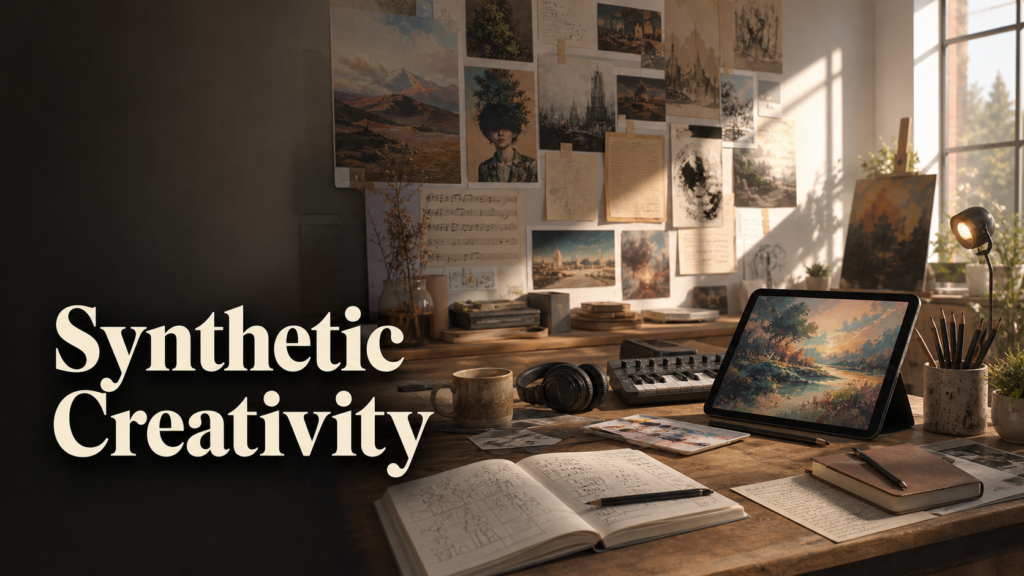
The arrival of synthetic creativity has not felt like a single invention. It has felt more like a weather change. At first there were strange images blooming online, faces with impossible earrings and hands with too many fingers. Then came songs in copied voices, poems drafted in seconds, logos generated before a client meeting ended, product mockups that looked polished enough to ship. What once seemed like a laboratory trick is now seeping into bedrooms, studios, classrooms, agencies, game engines, and phones.
That is why the cultural question is larger than whether machines can make pleasant pictures or plausible melodies. They already can. The deeper question is what happens when the tools of expression become abundant, responsive, and strangely fluent. Human creativity has always been shaped by the instruments available to it: charcoal, paper, the camera, the synthesizer, desktop publishing, the sampler, the smartphone. Generative AI is another instrument, but it is not simply a brush or keyboard. It behaves like a collaborator, imitator, archive, assistant, mirror, and sometimes thief, depending on where one stands.
To understand its likely impact, we need to look beyond the spectacle of novelty. Synthetic creativity will reshape who gets to make things, how taste is formed, how creative labor is valued, and how communities decide what feels meaningful. It may widen access to expression while also flooding culture with decorative noise. It may help artists explore ideas at extraordinary speed while also making audiences more suspicious of what they see and hear. It may give small teams the power of large studios while forcing society to renegotiate ownership, consent, credit, and authenticity.
How machines learned to generate culture-like things
Generative AI systems do not create in the human sense of wanting to be understood, grieving, flirting with failure, or arguing with a tradition. They create by learning patterns from examples. A model is trained on vast collections of images, text, music, code, or design materials, and during that training it absorbs statistical relationships: how words tend to follow one another, how shadows behave on a face, how a chorus resolves, how a chair might look if it belonged in a seaside hotel rather than a boardroom.
When a person types a prompt or supplies an image, melody, sketch, or paragraph, the system does not retrieve one stored object and hand it back. In most cases, it generates a new output by predicting what would plausibly satisfy the instruction based on learned patterns. This is why the results can feel both original and derivative. They are not copies in the simple sense, yet they are assembled from the echoes of existing human work. The model has no childhood memories, no private shame, no political risk, no body listening to a bass note vibrate through a floor. It has mathematics trained on culture.
The technical details differ across media. Image systems often begin with noise and gradually refine it into a coherent picture, guided by the prompt. Language models predict sequences of words, producing essays, scripts, explanations, and dialogue by navigating probability landscapes learned from text. Music models encode rhythm, harmony, timbre, and structure, then generate audio or symbolic notation that can resemble genres and performers. Design tools combine these abilities with constraints: brand guidelines, screen sizes, material costs, user flows, or manufacturing requirements.
For nontechnical readers, the most useful metaphor may be this: generative AI is a powerful pattern engine that can compress inherited culture into a responsive interface. Ask for a lullaby in the style of Antarctic science fiction, a poster for a festival that never happened, or a room layout for a narrow apartment with two anxious cats, and it will attempt an answer. The wonder comes from the responsiveness. The unease comes from the inheritance.
From scarce production to abundant variation
Creative work has never been only about imagination. It has also required time, training, materials, access, and often permission. A teenager with a song idea once needed instruments, recording equipment, collaborators, or years of practice. A founder needed a designer to visualize a brand. A filmmaker needed storyboards, concept art, and costly previsualization. Synthetic tools do not eliminate the value of mastery, but they lower the barrier to producing a first visible or audible draft.
This shift from scarcity to abundance is one of the most important cultural consequences. When images, jingles, copy, mood boards, animations, and rough prototypes can be produced almost instantly, variation becomes cheap. A designer can test twenty visual directions before lunch. A novelist can ask for alternative structures and discard most of them. A musician can generate textures, sample them, distort them, and build something more personal on top. For skilled creators, the tool can function like a tireless sketchbook that never complains about revisions.
Yet abundance changes perception. When every cafe can have handmade-looking posters, every small brand can have glossy campaigns, and every social feed can teem with cinematic images, polish loses some of its signaling power. The old assumption that a professional-looking artifact required professional resources becomes less reliable. Audiences may become harder to impress with surface beauty alone. The premium may move toward intention, context, trust, and the lived story behind a work.
This does not mean craft disappears. It means craft becomes less identical with manual execution. In some domains, the valued skill may shift toward direction: knowing what to ask for, what to reject, how to combine outputs, where to intervene, and how to preserve coherence across a project. The eye and ear become even more important, not less, because the machine can give countless plausible answers and very few necessary ones.
Music without hands, and the return of the listener
AI-generated music exposes the emotional complexity of synthetic creativity. Music is deeply bodily. We connect it to breath, touch, memory, and social ritual. A voice can feel intimate because it carries evidence of strain, age, accent, and presence. When AI systems produce convincing songs or imitate vocal qualities, they enter one of culture’s most sensitive rooms.
There are generous possibilities here. A composer with limited mobility may orchestrate ideas through text and voice prompts. A game studio may generate adaptive soundscapes that respond to a player’s choices in real time. Musicians might use AI to explore harmonies outside their habits, produce demo arrangements, restore damaged recordings, or create instruments whose tones could not exist physically. For amateurs, these tools can turn private humming into shareable sketches, making music less intimidating and more participatory.
The risks are equally intimate. Voice cloning can exploit the aura of a beloved performer without consent. Platforms could fill playlists with low-cost synthetic tracks designed to occupy attention without supporting musicians. If recommendation systems favor music that is cheap to generate and optimized for background consumption, the economic pressure on human artists could intensify. A culture can still have songs everywhere while making it harder for songwriters to live.
The future of music may therefore depend on whether listeners choose convenience alone or develop stronger appetites for provenance. People may want to know who made a track, what role AI played, whether a sampled voice was licensed, and whether the performer they hear is present in the work or merely simulated. Paradoxically, synthetic music could renew interest in live performance, local scenes, imperfect recordings, and musicians whose humanity is not an aesthetic filter but the source of the event.
Images, art, and the unsettled question of seeing
AI image generation has already transformed the visual web. It can produce fantasy landscapes, fashion editorials, architectural concepts, product shots, children’s book illustrations, surreal portraits, and fake historical scenes in seconds. For many people, this is their first encounter with a tool that turns language into visual form with such immediacy. It feels like dreaming with a control panel.
Artists are using these systems in divergent ways. Some treat them as idea engines, generating raw material to paint over, collage, animate, or critique. Others build entire practices around prompt craft, model training, and postproduction. Designers use them for mood exploration and rapid concepting. Educators use them to help students visualize abstract concepts. Independent creators who could not afford illustration now have a way to develop worlds, pitch stories, and communicate ideas visually.
But art is not only the production of images. It is also a relationship between maker, audience, history, and material. A painting carries decisions embedded in resistance: the drag of a brush, the drying of pigment, the revision that leaves a ghost beneath the surface. A photograph carries a claim, however complicated, that someone or something stood before a lens. An AI image carries a different claim: that a system synthesized a visual possibility from learned patterns and human instruction. It may be beautiful, but its beauty arrives through another route.
This distinction matters because seeing is a civic act as well as an aesthetic one. If images are easy to fabricate at scale, public trust becomes more fragile. Synthetic images can be used for satire, imagination, education, and art, but also for fraud, harassment, propaganda, and counterfeit evidence. The problem is not that fake images are new; manipulation predates photography itself. The problem is speed, realism, and distribution. Visual literacy will need to become a basic cultural survival skill, not a specialist concern.
Writing in the age of endless drafts
AI writing tools provoke a quieter anxiety than image or music generators, but the implications are profound. Language is how institutions think aloud. It is how students learn, companies persuade, governments explain, lovers apologize, patients describe pain, and communities remember themselves. When machines can produce fluent prose on demand, the function of writing begins to change.
For many practical tasks, the benefits are clear. A small business owner can draft clearer emails. A researcher can summarize literature faster. A person writing in a second language can gain confidence and precision. An advocate can tailor a message for different audiences. People who have ideas but struggle with formal prose may find a bridge between thought and expression. Used well, AI can reduce the friction that keeps knowledge trapped inside people.
Yet fluency is not the same as thought. A polished paragraph can conceal shallow reasoning, invented details, or moral evasiveness. If organizations use AI to produce more reports, statements, newsletters, and responses without adding judgment, the world may become more verbose and less communicative. Readers will face more text composed to sound adequate rather than to say something necessary.
The educational challenge is especially delicate. If students outsource writing before they have learned to wrestle with sentences, they may miss the way writing teaches thinking. The struggle to choose words, arrange evidence, and discover what one actually believes is not an obsolete inconvenience. It is part of intellectual formation. Schools will need to distinguish between using AI as a tutor or editor and using it as a substitute self.
Design as conversation with constraints
Design may be the field where synthetic creativity becomes most quietly embedded. Unlike a painting or poem, design usually solves a problem inside constraints. A chair must support a body. An app must guide attention. A package must protect an object, fit a shelf, obey regulations, and convey identity. Because design already involves iteration, testing, and compromise, AI tools can fit naturally into the workflow.
Generative design systems can propose layouts, materials, interface variations, logos, type pairings, floor plans, and product forms. When connected to data about cost, sustainability, accessibility, or user behavior, they can help teams explore trade-offs more quickly. A city planner might visualize multiple uses for an abandoned lot. A furniture maker might test structures that reduce waste. A healthcare team might prototype patient instructions that are clearer for older adults or people with low literacy.
The danger is that optimization can narrow imagination if the wrong goals are chosen. A system trained on past designs may reproduce familiar biases: interfaces that exclude disabled users, interiors that assume certain household structures, professional templates that erase regional character, beauty standards that flatten human variety. Design has always carried ideology in its measurements. AI can accelerate inclusive thinking, but it can also automate neglect.
The best design futures will keep humans close to lived experience. A model can generate a hospital waiting room plan, but patients know where anxiety gathers. A tool can propose a school website, but parents know which information becomes urgent at midnight. A system can optimize a transit map, but riders know the difference between a clean diagram and a safe transfer. Creative intelligence in design will mean combining computational exploration with human listening.
Authorship, ownership, and the uneasy inheritance of data
No discussion of synthetic creativity can avoid the question of training data. Many AI systems learned from enormous collections of human-made work, much of it gathered from the internet. Artists, writers, musicians, and photographers have argued that their labor was absorbed without consent, compensation, or meaningful control. Technology companies often reply that training is a form of analysis, not copying, and that the outputs are new. The legal and ethical debates are still unfolding, and their outcome will shape the creative economy for decades.
The issue is not merely technical. It concerns the social contract between culture and commerce. Human creativity has always been interdependent; every artist learns from predecessors, peers, scenes, genres, and traditions. But learning is not the same as industrial-scale extraction. When a person studies a painter, they bring limitation, interpretation, and accountability. When a corporation trains a model on millions of works and sells access to the resulting capability, the power balance changes.
Possible remedies include licensing systems, opt-out or opt-in registries, collective compensation funds, transparent datasets, model documentation, and stronger rights around voice and likeness. None is simple. Too much restriction could entrench large rights holders and make creative tools less accessible. Too little could normalize a world where individual makers provide the raw material for systems that undercut their livelihoods. The challenge is to protect human creators without freezing culture into permission grids so rigid that only the powerful can navigate them.
Credit may also need new vocabulary. A final work may involve a human concept, a model trained on public and private data, a prompt sequence, generated drafts, manual editing, and traditional craft. The old binary of human-made versus machine-made will often be inadequate. What audiences need is honest disclosure that is neither performative nor evasive. Creative provenance should help people understand the nature of a work, not reduce it to a purity test.
The labor question behind the magic
Synthetic creativity is often marketed as empowerment, and for many individuals it will be. But every tool that saves labor also redistributes labor’s value. Stock illustrators, translators, junior copywriters, session musicians, concept artists, layout designers, voice actors, and other creative professionals may face new competition from systems that produce acceptable work quickly and cheaply. Some will adapt and thrive. Others may find the lower rungs of their professions weakened or removed.
This matters because creative careers are usually built through apprenticeship and repetition. A senior art director once became senior by doing less glamorous production work. A novelist learns through drafts that fail. A designer develops taste by solving small problems under real constraints. If entry-level tasks vanish, industries may struggle to cultivate future experts. Today’s efficiency can become tomorrow’s talent drought.
At the same time, new roles will appear. Model curators, AI workflow designers, synthetic media editors, provenance auditors, prompt-literate producers, personalized learning creators, and rights negotiators may become normal parts of creative ecosystems. The question is whether these roles will offer dignity and stability or become another layer of precarious gig work. Culture benefits when creative workers can take risks, develop voices, and refuse bad commissions. It suffers when everyone is forced to chase volume.
The labor question should not be framed as artists against technology. Many artists love tools. The better frame is whether economic systems will use AI to expand human possibility or simply to cut people out of the budget. The same model can help a small studio make an ambitious film or help a large company replace a room of freelancers with a subscription. The ethical difference lies in choices made by institutions, platforms, clients, and audiences.
Authenticity after imitation becomes easy
As synthetic media improves, authenticity will become less about whether a work involved a machine and more about whether it carries accountable intention. A handmade object can be cynical. An AI-assisted work can be sincere. The presence of software does not determine meaning. Still, when imitation becomes effortless, people will search for signs that something matters beyond its surface.
We may see a renewed attachment to process. Audiences might value studio notes, live streams, drafts, sketches, behind-the-scenes recordings, and declarations of method. Not because process must justify every work, but because it restores relationship. If a song moved us, we may want to know whose grief shaped it. If an image persuades us, we may need to know whether it depicts an event or imagines one. If a political message appears in a trusted voice, we must know whether that voice was consented to or counterfeit.
There will also be a market for human-only creation, much as there is for acoustic performance, analog photography, handmade furniture, or local food. Such labels may sometimes become luxury signals, available mainly to those who can afford them. Yet they may also preserve practices that carry knowledge AI cannot embody. A potter’s hands know clay in a way a generator can describe but not feel. A choir knows the discipline of shared breath. A street mural knows the wall, the neighborhood, and the risk of being seen.
Authenticity will not require rejecting synthetic tools. It will require refusing to let convenience be the only value. Culture needs friction in measured amounts: the pause before publishing, the discipline of revision, the humility of learning from materials, the accountability of putting one’s name to a claim. Without friction, expression becomes vaporous. With too much, it becomes inaccessible. The task is balance.
Personalized culture and the shrinking commons
One of the most powerful future uses of generative AI will be personalized media. Children could receive bedtime stories that adapt to their fears and interests. Language learners could practice with dramas tailored to their level. Games could generate worlds around a player’s emotional style. Advertising could become individually composed persuasion. Therapy tools might produce exercises in a person’s preferred metaphors. Entertainment may become less like broadcasting and more like a private dream factory.
This could be wonderful. Personalized creative systems may help people learn, heal, explore identity, and find joy in forms that mass culture never provided. A child who rarely sees her family structure represented could inhabit stories where it is ordinary. An elderly person with memory loss could hear songs shaped around fragments of personal history. A person in a remote place could collaborate with tools that respond to their language and landscape.
But shared culture has civic value. Societies need common references, public arguments, collective songs, widely witnessed stories, and artworks that gather strangers into the same emotional room. If every person receives a custom stream, culture may become more intimate but less communal. The algorithmic home can be comforting, yet it can also become sealed, reflecting our preferences until surprise grows rare.
The risk is not just isolation. Personalized synthetic media could manipulate with extraordinary precision. A political message generated for one person’s anxieties may never be visible to others who could challenge it. A commercial narrative may adapt until it finds the exact emotional lever. When creativity becomes interactive persuasion at scale, regulation and public literacy will need to evolve. The right to a shared reality may become one of the defining cultural rights of the AI era.
What human creators may become
The optimistic vision is not that AI replaces the artist, but that it changes the artist’s center of gravity. Some creators will become conductors of systems, shaping flows of possibility. Some will double down on embodied practice, emphasizing performance, material, place, and direct human encounter. Some will hybridize, moving between generated drafts and handmade interventions until the boundary is less important than the result. The creative field will not move in one direction. It will splinter beautifully and uneasily.
In this landscape, taste becomes a major human skill. Taste is not mere preference. It is cultivated attention, ethical sensitivity, historical awareness, and a sense of proportion. It knows when something is moving and when it is merely impressive. It can detect the difference between surprise and randomness, elegance and sterility, empathy and its simulation. As generation grows easier, selection becomes more consequential.
So does purpose. Before synthetic tools, many creative choices were constrained by what could be made. Now more people will face the harder question of what should be made. If a thousand variations are available, why choose one? If a voice can be cloned, should it be? If a design can optimize attention, toward what end? The machine can assist with means, but it cannot absolve humans of ends.
The next creative education should therefore teach both tool fluency and moral imagination. Students should learn how models work, where their data comes from, how to evaluate outputs, and how to cite or disclose assistance. They should also study art history, rhetoric, community impact, labor politics, and the psychology of attention. The future creator will need technical agility, but also the old virtues: patience, courage, curiosity, memory, and care.
A future made of collaborations, disputes, and choices
Over the next decade, synthetic creativity will become ordinary. The novelty will fade, and the deeper structures will matter more: platform rules, compensation systems, cultural norms, classroom policies, union contracts, licensing frameworks, and audience expectations. Some media will be labeled, some will be invisible, and some will be so hybrid that labeling every contribution becomes impractical. The debates will not end because they are not only about technology. They are about value.
There will be scandals: fabricated evidence, unauthorized digital performers, contests won by undisclosed AI work, beloved artists discovering their styles bundled into commercial tools. There will also be breakthroughs: films made by tiny teams, accessibility tools that let more people express themselves, scientific visualizations that reveal hidden patterns, community archives transformed into living educational experiences, new genres born from collaboration between human intention and machine variation.
The healthiest cultures will avoid both panic and surrender. Panic treats every synthetic work as a threat and misses the expanding agency these tools can offer. Surrender treats every capability as destiny and forgets that societies can set boundaries. Between those extremes lies the work of building norms that honor consent, reward originality, support livelihoods, disclose deception, and keep creative power widely distributed.
We should remember that creativity has never been pure. It has always involved influence, tools, accidents, patrons, markets, rituals, and technologies. The printing press changed memory. Photography changed portraiture. Recorded sound changed performance. Sampling changed authorship. The internet changed distribution and attention. Each shift produced loss and possibility together. Generative AI belongs to that lineage, but its speed and scope require unusual vigilance.
The human question inside synthetic creativity
Perhaps the most important thing AI will reveal is not what machines can make, but what humans mean by making. If creativity is only the production of novel artifacts, then machines are already formidable competitors. But if creativity is also a way of metabolizing experience, forming identity, confronting mortality, building solidarity, and leaving traces for others, then human creativity remains rooted in conditions AI does not share.
A generated song can be beautiful, but it does not need comfort. A generated painting can be striking, but it has never watched light change across a childhood room. A generated essay can be lucid, but it has no stake in being believed. This does not make synthetic work worthless. It clarifies the difference between pattern and presence. Human culture may increasingly include both, and the art will be in knowing how to relate them.
The future will not ask whether AI belongs in creativity. It is already there. The better question is what kind of creative civilization we want around it. One path leads to an endless feed of frictionless content, optimized until it becomes emotionally weightless. Another leads to broader participation, richer tools, fairer systems, and a renewed appreciation for the human acts that cannot be automated: witnessing, choosing, caring, remembering, and taking responsibility.
Synthetic creativity will change the surface of culture first. The images will shimmer, the interfaces will respond, the songs will appear as if summoned from air. But beneath the surface, the older drama continues. Humans will still be trying to say: I was here, I felt this, I saw the world in a way I could not keep to myself. The machines may help generate the forms. We must decide what deserves to endure.