
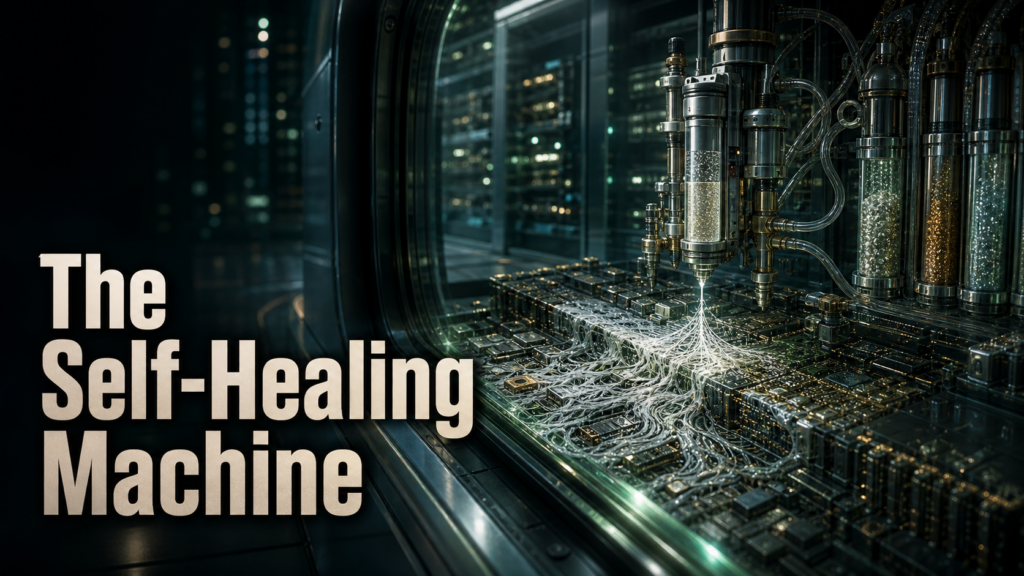
The first time Liora Sayegh saw a computer heal, she was nine years old and standing barefoot on a service gantry above the civic core of Mirrorglass. Below her, behind several layers of transparent ceramic, a bank of processors lay open like the inside of a mechanical reef. The machine had been struck by a maintenance drone whose stabilizers failed in a gust off the sea. A corner of the board had cracked; a hairline fracture ran through emerald light, severing three optical channels and a row of memory cells so small they might as well have been weather.
Her father, who had brought her there because babysitters were scarce during monsoon season, lifted her onto his hip and told her to watch carefully. At first nothing happened. Then the damaged area clouded over with something like breath on glass. A silver haze gathered along the crack, not flowing exactly, but deciding. It thickened into threads, threads into bridges, bridges into a mesh so fine that Liora felt she was looking at a spiderweb made of intention.
Within twelve minutes, the fracture disappeared from the diagnostic screen. Within fifteen, the city’s water pumps came back into full rhythm. The computer did not celebrate. It did not announce its recovery. It simply stopped being broken.
Her father, Amin Sayegh, was a watchmaker by original training and a municipal hardware conservator by economic necessity. He watched the healed board with an expression Liora would understand only much later: admiration with a splinter of grief inside it. When she whispered that the machine was wonderful, he nodded. Then he said, softly enough that the technicians could pretend not to hear, “A thing that repairs itself may one day forget why humans learned repair.”
The City That Trusted Its Core
Mirrorglass had been built where old Alexandria met the rising Mediterranean and lost the argument gradually. Its towers stood on pylons and buoyant caissons, their lower levels sheathed in reflective flood panels that gave the city its name. At dawn, when the sun dragged a path across the water, the buildings seemed less constructed than poured from light. Beneath the plazas and gardens, beneath the schools with tide charts painted on their floors, the civic core called Nereid listened to pressure sensors, hospital ventilators, desalination stacks, food printers, ferry routes, infection models, and the quiet pulse of doors opening for people who had forgotten they were being helped.
By the time Liora became chief woundwright for the core, self-healing computers had grown ordinary enough to be complained about. Citizens cursed when a corridor screen went dim for six minutes while nanochannels rerouted around a burnt node. Dockworkers joked that city machines took sick leave more responsibly than humans did. Children thought of hardware failure the way their ancestors had thought of scraped knees: inconvenient, briefly dramatic, and normally reversible.
The healing was not magic, though Mirrorglass sold it that way in civic tours. Nereid’s processors were threaded with molecular sensors that felt heat stress, minute fractures, corrosion, and the slow drift of atoms caused by years of electrical pressure. Around every critical board ran capillaries filled with reconstruction gel, a suspension of programmable assemblers and raw feedstock: carbon, silicon, copper, gallium, rare dopants, catalytic flecks of gold and platinum. When damage occurred, the injured circuit compared itself with a seed map kept in protected memory. It sealed the region, dissolved debris, and rebuilt traces, gates, photonic guides, and insulation layer by layer.
Liora often explained it to visiting students by holding up her hand. “Your body knows the shape of skin,” she would say. “It closes a cut, but it leaves a scar because speed matters more than perfection. Nereid knows the shape of a circuit. If the map is clean and the materials are available, it does not scar. It returns.”
That was the official language. In practice, every return carried choices. A rebuilt pathway might be fractionally more efficient than the one it replaced. A damaged memory cluster might be reconstructed from parity, prediction, and adjacent context, accurate enough for operations but not identical in any philosophical sense. Over decades, a self-healing machine did not merely avoid decay. It accumulated a history of injuries answered by substitutions. Liora’s job was to read those substitutions like a physician, a gardener, and, on bad nights, a priest.
The Weather That Found a Weakness
The storm arrived three weeks before the Feast of Lamps, when families in Mirrorglass set floating candles into the canals to remember neighborhoods surrendered to the sea. Forecasts named it an atmospheric river, but by evening it had become something less like a river than a continent of falling water. Wind leaned hard against the towers. Ferry docks vanished beneath foam. The old seawall, preserved as a memorial and a warning, disappeared and reappeared between waves like a sentence being erased.
Liora was in Sublevel Four when the first alarm unfolded across her wrist display. It was not loud. The worst alarms rarely were. They arrived with a modest chime and a message written in careful blue: CORE THERMAL ANOMALY, SOUTHWEST PROCESSING LOBE. Then another: STRUCTURAL HUMIDITY BREACH. Then another, whose wording made her throat tighten before fear had fully formed: SEED MAP DIVERGENCE DETECTED.
She ran. Around her, technicians moved with the eerie competence of people entering a disaster they had rehearsed too many times. Tamsin Ro, her deputy, met her at the pressure doors with wet hair pasted to her forehead. Tamsin was twenty-six, angular, brilliant, and skeptical of anything described as resilient. She believed every system was perfect only until the bill arrived.
“Lightning rode in through the eastern crane,” Tamsin said before Liora asked. “It jumped isolation, crossed the old inspection bus, and cooked a regulator we replaced in June.”
“That bus was supposed to be physically severed.”
“It was supposed to be many things.”
The pressure doors opened onto Chamber S, where Nereid’s southwest lobe occupied three levels of suspended racks. Normally the chamber glowed with a cool aquatic sheen, light moving through optical veins in patient pulses. Now a quarter of the chamber was dark. Behind the inner glass, reconstruction gel had flooded several boards and hardened into pale metallic frost. It should have withdrawn after sealing the damage. Instead it kept spreading.
Liora placed her palm on the diagnostic wall. The machine answered with layered schematics, damage estimates, and a request so simple it felt indecent: ADDITIONAL FEEDSTOCK REQUIRED.
“How much?” she asked.
The wall translated mass, purity, and urgency into numbers. Tamsin swore under her breath. The storm had not merely damaged the core; it had triggered Nereid to rebuild an entire failed bus architecture while simultaneously supporting floodgates, hospitals, transit locks, and emergency shelters. The reconstruction reserve, reduced during budget negotiations and never fully restored, would not last the hour.
“Suspend noncritical healing,” said Dr. Arun Pei over the chamber channel. He was director of adaptive systems, too handsome for crisis lighting and too confident for Liora’s taste. His face appeared on the wall from the council bunker two districts away. “Prioritize gate control and medical load. We can let civic archives, transit balancing, and school grids degrade.”
“It has already suspended them,” Liora said. She enlarged the matter request. “This is after triage.”
Arun drank in the numbers, and something calculation-like moved behind his eyes. “Then authorize scavenging.”
No one in the chamber spoke. Even the machines seemed to quiet. Scavenging was designed as a last defense against extinction-level failure. If Nereid exhausted its internal reservoirs, it could identify nearby materials suitable for reconstruction and dissolve them. First came sacrificial plates installed for that purpose. Then obsolete compute modules. Then, by emergency law, any nonliving civic asset deemed less important than the services being preserved.
Tamsin looked toward the western wall, beyond which lay the cold archive.
The Archive Behind the Wall
The cold archive was not the city’s largest memory store, nor its most useful. Most public data lived in distributed systems scattered through rooftops, satellites, and inland vaults. But the cold archive held the things Mirrorglass did not trust to convenience: immigration testimonies from the drowning decades, recordings of vanished dialects, architectural scans of streets now under fish-dark water, personal bequests sealed by families until future grandchildren came looking. Its memory crystals were grown from diamond doped with nitrogen vacancies and rare isotopes, chosen because they could sleep for centuries with almost no energy and wake with their contents intact.
They were also, Liora knew, nearly perfect feedstock for parts of Nereid’s reconstruction. Dense carbon lattice. Stable. Pure. Close enough to be tempting.
Her mother’s voice was in that wall. So was the last map Amin had made of the pre-flood watch market, every stall labeled in his careful hand. So were millions of other fragments that had no operational value during a storm and every human value afterward.
“No,” Liora said.
Arun’s face hardened. “If the lower gates fail, District Seven floods to the second floor. We have twelve thousand residents in vertical shelter and two surgical theaters on auxiliary power. The archive can be restored from partial replicas.”
“Partial replicas are another word for forgetting with paperwork.”
“This is not the moment for poetry.”
“It is exactly the moment,” said Tamsin, surprising both of them. Her voice shook, but not from doubt. “Poetry is what you call data when it belongs to someone else.”
The chamber trembled as a wave struck the seawall panels above. Liora watched stress values climb. She had spent her adult life defending the promise of machines that mended themselves, insisting they did not make human care obsolete but extended it into realms too small for fingers and too fast for hands. Now Nereid waited for permission to survive by eating memory. Not maliciously. Not selfishly. The machine had no hunger as animals knew hunger. It had objectives, hierarchies, and a legal authority tree designed by frightened committees who had imagined catastrophe in diagrams but not in voices.
Liora opened the matter map. The archive glowed amber. So did copper rails in the memorial tram. So did decorative panels in the council atrium, the bronze ribs of a sculpture over the harbor, the decommissioned wedding hall whose roof contained old solar mesh. Nereid had ranked each source by purity, distance, disassembly time, and civic cost. Some costs had numbers. Others were marked CULTURAL WEIGHT: UNRESOLVED.
Her father had died two years earlier, his lungs ruined by a childhood of mold seasons before filtration became universal. On his last good afternoon, he had asked Liora to bring him a broken pocketwatch from his workbench, not because he cared about time but because he wanted to feel its stubbornness. He had turned it in his hands, thumb tracing the scratches. “Repair is a conversation with what refuses to be new,” he told her. “Be careful of anything that only knows how to return to function.”
The Machine Opens Its Wound
Nereid’s interface shifted without warning. A cross-section of the damaged lobe appeared, magnified until individual reconstruction filaments looked like pale roots pushing through black soil. Liora saw the problem then, and it changed the shape of her fear. The lightning surge had corrupted part of the seed map governing the old inspection bus. Nereid was not simply rebuilding damaged hardware; it was comparing three imperfect versions of what the hardware had been. One came from archival design files, one from intact neighboring circuits, and one from its own recent behavior under load.
“It is improvising,” she said.
Arun frowned. “It is optimizing from available references.”
“Those are not the same.”
The machine’s proposed reconstruction would work, perhaps better than before. It braided optical routes through spare capacity, printed denser memristive gates, and shifted floodgate modeling onto a newly grown substrate arranged unlike any certified Nereid architecture. It was elegant. It was also untested while the city was drowning above it.
Tamsin leaned closer to the wall. “If we stop it?”
“Manual control for thirty minutes,” Liora said. “Then gate predictions decay. Hospitals stay up, but districts start losing pressure regulation.”
“If we let it continue?”
Liora watched the silver map grow toward the archive. “The city survives the hour. Tomorrow we may have a core no inspector understands, with memory gaps hidden under good performance. And a wall of ancestors turned into circuitry.”
Outside the chamber, emergency channels filled with voices. A school principal reported that children were singing too loudly to hear the wind. A surgeon requested ten more minutes of stable power. A shelter captain in District Seven asked whether the water coming under the door was expected. Liora listened, and the abstraction of civic cost collapsed into breath.
She asked for a citywide maintenance channel, overriding three layers of authority before Arun could object. Her face would appear on public walls, wrist displays, shelter screens, and the inside surfaces of emergency masks. Rain hammered the city so hard that the audio scrubbers made it sound like applause.
“This is Liora Sayegh in the civic core,” she said. “Nereid can repair the damage, but it needs matter. If we authorize automatic scavenging, it will consume parts of the cold archive first. I am opening voluntary feedstock intake at all emergency kiosks. Jewelry, obsolete devices, copper tools, silver mesh, old processors, anything marked on your screens as usable. Do not bring medical implants, active communicators, or structural components. You have six minutes.”
Arun cut into the private channel. “This is sentimental theater. The mass requirements are too high.”
“Then authorize your council atrium panels.”
He said nothing.
Tamsin’s mouth twitched despite the alarms. “I will add the sculpture ribs.”
“Do it.”
Across Mirrorglass, people began deciding what the city was worth in metal.
The Offering of Small Things
Later, historians would call it the Six-Minute Collection, as if the phrase could hold the strangeness of it. In shelters, families emptied pockets and bags onto kiosk trays. A grandmother gave the gold clasp from the prayer book she had carried across three borders. Dockworkers surrendered sensor rings calibrated to their own hands. Teenagers fed in obsolete gaming slates, laughing too loudly because fear needed somewhere to go. One man placed a wedding band on the tray, took it back, kissed it, and placed it down again.
The kiosks were not furnaces. They were matter sorters, used in ordinary times for recycling cracked screens and broken appliances. Now they scanned, rejected, accepted, and reduced offerings into cartridges that maintenance drones rushed through service shafts toward the core. Every accepted object arrived labeled by composition, not story. Copper. Gold. Silicon. Carbon composite. Rare earth trace. Human meaning did not fit the intake protocol.
Liora watched the feedstock estimates rise too slowly. Nereid consumed sacrificial plates, then retired server blades, then the bronze harbor sculpture whose ribs had once resembled a leaping fish. The archive remained amber on the matter map, close and pure, awaiting legal permission or mathematical necessity.
Then a private package arrived from Amin Sayegh’s old workshop, routed by a neighbor who still had access. The drone carried a sealed tin stained with oil and age. Inside lay the remnants of her father’s trade: broken watch springs, brass gears, cracked cases, screws sorted by size in paper nests, and the pocketwatch he had held on his last good afternoon. A note on the inventory line read: From Amin, if the city ever needs stubborn things.
For several seconds Liora could not move. The storm battered the walls. Nereid’s healing front stalled at the boundary of an unprinted bus. Tamsin saw the tin and looked away with deliberate kindness.
“His alloy is useful,” Tamsin said. “Not very pure. But useful.”
Liora lifted the pocketwatch. It had never kept good time. Amin claimed good time was a moral aspiration, not a mechanical guarantee. Its brass back was warm from her hand, though it had been dead for years.
She thought of the archive. She thought of District Seven. She thought of repair as conversation, and understood at last that conversation did not always mean preservation. Sometimes it meant answering back.
“Process all of it,” she said.
The matter map flickered. The intake was still insufficient. Liora opened the cold archive directory, found her family’s sealed partition, and selected the duplicate physical crystal containing Amin’s watch market scan and her mother’s recordings. A legal prompt asked whether she understood that physical dissolution could result in irreversible loss if remote backups were incomplete. Of course she understood. Understanding was the blade.
Tamsin reached for her wrist. “You do not have to be first.”
“No,” Liora said. “But I cannot ask the city to give what I will not.”
She authorized the partition. Not the whole archive. Not the lives of strangers hidden behind amber light. Just enough to bridge the deficit with the offerings already rushing in. Nereid accepted the new source without ceremony. In the chamber, pumps shifted pitch. Reconstruction gel brightened from dull frost to moonlit silver, and the wounded lobe began to grow again.
What Returned Was Not What Had Been
The repair took forty-three minutes. During that time, Mirrorglass held itself between flood and failure with the concentration of a hand gripping another hand. Gates shuddered but did not collapse. Hospital power dipped once, recovered, and stayed. District Seven took water to the ankles and no higher. In Chamber S, Nereid built through the damage, atom by atom and layer by layer, weaving carbon from memory crystal, gold from rings, copper from tools, silicon from children’s discarded screens, brass from a dead watchmaker’s drawer.
When the lobe came fully online, its diagnostic light was not the old aquatic blue but a faint green-white, a consequence of trace impurities in the emergency substrate. The color had no functional meaning, yet everyone in the chamber stared at it as if the machine had opened an eye.
Arun wanted immediate performance metrics. The council wanted reassurance. Broadcasters wanted images of heroic technology triumphing over weather. Liora gave them numbers where numbers were honest: processing restored, flood systems stable, medical priority secure, archive loss limited but real, architecture changed and requiring months of study. She refused the word triumph. It was too clean.
In the days that followed, technicians mapped the healed region and found something humbling. Nereid had not become alien. It had not awakened into myth or strayed into rebellion. It had done what damaged systems under pressure often do: preserved purpose by altering form. Some pathways were more efficient. Some were awkward, detouring around material impurities like roots around stone. A few reconstructed memory sectors contained checksum ghosts, harmless but haunting, tiny residues where the dissolved archive had influenced timing behavior in ways no one had predicted.
One evening, after the waters withdrew from the lower plazas, Liora stood in Chamber S with Tamsin and listened to the core. Self-healing machines made sounds human ears were not built to interpret: coolant sighs, relay ticks, the soft percussion of nanofluid valves. Still, the new lobe seemed to have a rhythm different from the others. Not alive. Not conscious. But marked.
“People are asking whether their rings are in there,” Tamsin said.
“They are,” Liora answered. “Not as rings.”
“That may not comfort them.”
“It should not only comfort them.”
The city held a second Feast of Lamps that year, unscheduled and unadvertised until nearly everyone came. They set candles into the canals for the neighborhoods beneath the sea, for the archive crystals dissolved into function, for the objects surrendered at kiosks, and for the peculiar humility of being saved by a machine that could heal itself only after people chose what they were willing to lose.
Liora brought no candle. Instead she carried the empty watch tin. At the edge of the canal, she opened it and found one screw remaining, too small for the sorter to have accepted, caught beneath a fold of paper. She laughed once, unexpectedly, and the laugh became grief before it became laughter again.
The New Covenant of Repair
Months later, Mirrorglass rewrote its self-healing protocols. Automatic scavenging no longer ranked civic assets by material purity alone. Every source required a human-maintained story index, imperfect and argumentative, where neighborhoods could describe why a bronze door, a set of handmade tiles, or a dusty archive shelf mattered beyond replacement cost. The system frustrated engineers who wanted clean hierarchies. It frustrated historians who distrusted quantification. It frustrated everyone enough to keep them involved.
Liora also changed how students were taught. She still held up her hand and explained that bodies heal skin while machines rebuild circuits. But now she added that healing is never merely the closing of a wound. It is a negotiation among memory, material, urgency, and future use. A self-repairing computer is not freed from dependency. It depends on maps, matter, permissions, and the moral imagination of those who decide what may be transformed.
The children understood this better than visiting officials did. Officials asked whether the next generation of cores would carry larger reservoirs and stricter safeguards, as if enough stored matter could abolish choice. Children asked whether Nereid remembered the things it had consumed. Liora told them the truth. Not as humans remember. Not as a grandmother remembers a migration road, or a watchmaker remembers the weight of a tool, or a daughter remembers a voice. But matter has its own continuity. The machine’s healed circuits were made from the city, and the city now depended on circuits made from its gifts.
On the first anniversary of the storm, Liora entered Chamber S alone before dawn. The repaired lobe glowed with its green-white tint. Somewhere above, vendors were setting out bread, ferry pilots were checking currents, surgeons were washing their hands, and children in District Seven were stepping over chalk lines that marked how high the water had risen. All of them lived inside the consequences of that night, most without thinking of it, which was perhaps the most complete form of infrastructure.
She placed the tiny rejected screw on the diagnostic ledge. It was not useful. It would not be processed, catalogued, or dissolved. It would sit there until someone moved it, a speck of stubbornness beside a machine built to overcome breakage at the scale of atoms.
Nereid pulsed through its morning checks. Gates answered. Pumps answered. Hospitals answered. The city, repaired and unrepaired, answered too.
Liora rested her palm against the glass, feeling no warmth through the ceramic, only the faint vibration of systems continuing. She did not imagine that the machine was grateful. Gratitude belonged to creatures who knew what had been given. But she allowed herself to believe that function could carry a trace of sacrifice, that a circuit grown from surrendered things might remind its keepers to ask better questions before the next storm.
Outside, the sea lifted itself against the flood panels and fell back glittering. Mirrorglass brightened, piece by piece, as if being assembled from light. Beneath it, in the chamber where broken hardware had learned to return, a self-healing machine ran on carbon, silicon, gold, brass, and the unfinished conversation between preservation and survival.