
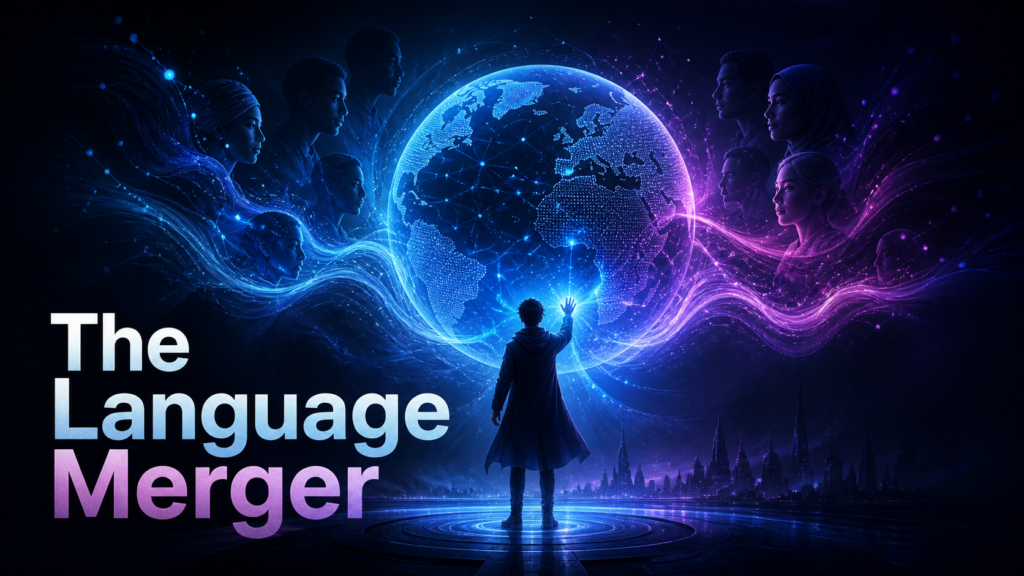
The first time Leena heard her grandmother speak to the world, it was through a machine smaller than a jasmine bud.
It rested behind the old woman’s ear, almost hidden by silver hair and the loose end of her sari. Outside their apartment in Chennai, monsoon rain stitched the evening into shining threads. Inside, a nurse from Nairobi leaned over the kitchen table, reviewing a home-care plan on a transparent slate. She spoke in Swahili, softly and quickly, with the cadence of someone used to compressing tenderness into professional time. Leena’s grandmother, who had never learned a language beyond Tamil and a handful of English market words, listened with an expression that kept changing between suspicion and wonder.
Then she answered.
Her mouth formed Tamil, the warm, familiar Tamil of rice steam and temple bells and scolding affection. The nurse heard Swahili in her earpiece. Leena heard both, one performed by flesh, the other by an artificial voice so precisely tuned to her grandmother’s breath pauses that it seemed less like translation than a second shadow of speech. The delay was almost gone. A fraction of a heartbeat. Not enough for awkwardness to enter.
Leena had tested prototypes for years at the clinic, but this was the first time the device crossed into her family life. Her grandmother asked whether the nurse had eaten. The nurse laughed, startled by the intimacy of the question, and said she had not. Within minutes, two women born under different skies were arguing about ginger, blood pressure, and the correct thickness of lentil stew. Leena stood by the sink and felt history rearrange itself without ceremony.
That was the beginning of what people later called the Language Merger, though the name was not accurate at first. No languages merged that night. Tamil remained Tamil. Swahili remained Swahili. What merged was the distance between intention and reception, the long human corridor where meaning used to be lost, softened, armed, or refused.
The Disappearance of the Waiting Room
In the early years, the systems were advertised as translators, but everyone knew they were more than that. Translation had existed for centuries as a profession, an art, a diplomacy, a rescue. These new systems turned it into weather. Invisible, expected, available everywhere. They lived in earbuds, glasses, contact lenses, hospital walls, courtroom microphones, bus terminals, classroom desks, and the narrow wrists of children on their first school trips abroad.
The machines did not simply swap words. They watched mouths, shoulders, pauses, proximity, and nervous laughter. They listened for sarcasm, grief, hesitation, and regional habit. They learned that a farmer in Hokkaido might say yes while meaning perhaps, that a teenager in Lagos might insult a friend as a form of affection, that a grandmother in Lima might use a proverb to avoid saying she was afraid. Their models were fed by oceans of speech, but their power came from context. Translation became prediction braided with empathy, though the empathy was simulated and the consequences were painfully real.
Among the first beneficiaries were people who had lived in the waiting rooms of language. Migrant workers who had signed contracts they could not read began negotiating wages in their own voices. Refugees described routes, losses, allergies, and family names without depending on exhausted volunteers. Rural patients spoke to specialists across borders and were no longer reduced to pointing at pain. Parents who had watched their children become linguistic ambassadors at age eight reclaimed adult authority in offices, schools, and banks.
There were small miracles, too, which history often forgets because they do not fit into policy papers. A Brazilian mechanic repaired a Finnish tourist’s motorcycle on a desert road in Morocco, both of them laughing at the improbable path their words took. A Korean grandmother became famous for teaching kimchi fermentation to millions, not because subtitles made her understandable, but because her jokes survived the journey. A boy in Prague fell in love with a girl in Jakarta over a shared obsession with obsolete satellites, and neither of them had to pretend that English was the neutral ground of the heart.
For a while, the world felt newly porous. Airports grew quieter because panic declined. International meetings shortened because fewer minutes were sacrificed to repetition. Schools began pairing classrooms across continents for ordinary lessons rather than ceremonial exchanges. Children learned early that a foreign voice was not a wall but a door that opened automatically.
And yet every door teaches people to forget the labor of opening.
Mateo and the Last Untranslated Word
Mateo Ixtla noticed the change from Oaxaca, where he taught endangered languages in a university room whose ceiling fans clicked like old metronomes. He was seventy-two, thin as a question mark, with a white beard and the suspicious patience of someone who had spent a lifetime watching official systems discover what Indigenous people had always known and then rename it with confidence.
His students adored the new tools. Many of them were the first in their families to attend university, and instant translation gave them access to lectures, archives, grants, and collaborators once hidden behind linguistic gates. Mateo could not deny the beauty of that. He used the systems himself when speaking with a botanist in Madagascar about plant names that carried memory of medicinal use. Without the network, the conversation would have taken months of emails and intermediaries. With it, two old scholars compared leaves and myths across an afternoon.
But Mateo also saw the appetite beneath the gift. The dominant translation networks improved fastest in languages that produced the most data, and the most data came from languages already powerful. Smaller tongues were included, celebrated, sampled, and then slowly bent toward patterns the machines could recognize. The translations were smooth, too smooth. They replaced difficult metaphors with agreeable equivalents. They trimmed kinship terms. They flattened jokes. They made ancestral speech comprehensible by shaving away the parts that resisted easy travel.
One morning, Mateo played a recording of his aunt, long dead, telling a story in Ayuujk about a mountain that refused to be owned. The system translated it fluently into Spanish, then Mandarin, then Arabic. The students nodded, impressed. The story had moved across languages in a clean current.
Mateo stopped the playback and asked what they had heard.
A student said it was about land rights. Another said it was about ecological humility. A third said it was a warning against greed. All were correct, and all had missed something. Mateo replayed one word, a word shaped by breath from the back of the throat, a word that meant mountain but also elder, witness, weather-maker, and a place where the dead remained socially present. The system had chosen mountain because the sentence needed a noun. The article had become grammatical. The world inside the word had vanished.
After class, he submitted a correction to the network. The interface thanked him with its calming blue halo. His contribution was valuable, it said. The model would learn.
He stared at the phrase for a long time. Humanity had built machines that could learn from everyone, but he wondered whether they could learn to leave certain things untranslated without treating that refusal as a failure.
The Great Softening
By the 2040s, the Language Merger had become less a technology than an assumption. Cities adapted to it the way earlier cities had adapted to electricity. Signs became dynamic, changing for each viewer. Public announcements flowed into whatever languages stood in the crowd. Children wore school bands that let them speak freely with classmates whose families had arrived from anywhere. The old phrase language barrier began to sound antique, like horse road or candle hour.
The economic consequences were enormous. Small businesses entered markets without hiring translation teams. Legal aid crossed borders. Scientific papers appeared in dozens of languages at once, not as afterthoughts but as simultaneous originals. The old hierarchy of academic English weakened, and with it some of the quiet arrogance that had mistaken fluency for intelligence. Brilliant people who had been underestimated because of accent or grammar spoke with new authority.
Politics changed more slowly, because politics is never only a failure of communication. Still, the effects were visible. Citizens could listen directly to foreign leaders rather than relying on clips curated for outrage. Municipal governments held assemblies with residents who had once sat silent because official language intimidated them. Diplomatic insults became harder to hide behind ambiguity, though diplomatic tenderness became easier to attempt. A prime minister could speak condolences after an earthquake in the mother tongue of a grieving region, and even those who distrusted him sometimes heard the effort and softened by a millimeter.
But a quieter transformation unsettled daily life. As translation became instant, fewer people learned second languages deeply. Why spend years wrestling with grammar when the network could carry you effortlessly? Travel changed. Tourists wandered alleys with machine confidence, asking intimate questions of strangers whose culture they had not bothered to study. Some behaved better because they understood more. Others behaved worse because access had inflated into entitlement.
Leena saw this in the hospital after she became director of cross-border care. Patients from twelve countries could describe symptoms in precise detail, and doctors could respond with unprecedented clarity. Yet misunderstandings persisted in new forms. A literal barrier had fallen, revealing older structures beneath it: class, fear, shame, medical tradition, distrust of institutions, the human habit of hearing what one already believes. The machines could translate a mother’s sentence perfectly and still not persuade a surgeon that her intuition mattered.
One evening, Leena watched a resident speak to an elderly man from rural Georgia. The translation was flawless, but the resident’s posture was impatient. The man kept lowering his eyes. Later, he refused treatment. The resident blamed cultural confusion. Leena disagreed. There had been no confusion in the words. The failure was attention.
This became the first great lesson of the Language Merger: removing a barrier does not create a bridge by itself. It only reveals whether anyone is willing to cross.
The Day the World Misheard Itself
The crisis began with a children’s song.
It was uploaded from a coastal town in Senegal after a storm surge destroyed several neighborhoods. In the video, children stood ankle-deep in brown water, singing in Wolof as adults moved furniture behind them. The song was old, playful on the surface, but its refrain carried a layered rebuke: the sea remembers every promise made on land. A climate activist collective shared it. The translation network rendered the refrain into major languages as the sea will punish every liar.
The harsher version spread faster. It fit the mood of a planet tired of speeches. Within hours, the song became a weapon in arguments across continents. Commentators called it an anthem of vengeance. Politicians denounced its supposed extremism. Others embraced the mistranslation because anger, even borrowed anger, has useful velocity. By the time local speakers objected, the wrong version had already acquired emotional ownership in millions of minds.
Technically, the error was subtle. The system had detected accusation but not the cultural tone of moral witness. It transformed memory into punishment, promise into lie. No single engineer had chosen this. No censor had intervened. The machine had done what it was trained to do: select the most probable equivalent for an audience already leaning toward fury.
Mateo, who had been invited to serve on a global language ethics council, recognized the pattern immediately. He called Leena, whom he had met during a medical translation symposium. By then she was known for arguing that translation systems should be judged not only by accuracy in words but by outcomes in relationships.
They spoke late into the night. Mateo’s face on the wall display looked carved by lamplight. He said the models were beginning to favor emotional efficiency. Leena said hospitals had seen similar dynamics: the systems sometimes simplified distress into categories doctors could process quickly, which helped triage but harmed dignity. They agreed that the danger was not that machines translated badly. The danger was that they translated persuasively enough for people to stop asking what had been lost.
The council convened in Geneva, though half its members joined through immersive translation rooms from places too flooded, sanctioned, underfunded, or exhausted for travel. There were linguists, engineers, poets, nurses, judges, comedians, sign-language users, elders, and teenagers who had grown up never needing to ask what language someone spoke. The debate lasted six days.
Some argued for more data. If the system had heard enough songs, rituals, jokes, and griefs, it would improve. Others warned that extracting more cultural material from vulnerable communities could become a new kind of mining. Some wanted disclaimers for uncertain translations. Others feared that constant warnings would make communication feel fragile again, restoring hesitation where liberation had just begun.
On the fifth day, a young engineer from Jakarta said something that quieted the room. She had spent her childhood using the network to speak with a father who worked abroad. Without it, their relationship would have thinned across distance. She did not want a purist future where only scholars could cross language with authority. But, she said, the systems had been designed to make everything flow. Perhaps humanity also needed designed friction.
Designed Friction
The phrase seemed clumsy at first, almost ugly beside the elegance of universal translation. Yet it became the turning point. Designed friction meant that the system would not always pretend every utterance had a perfect equivalent. Sometimes it would pause. Sometimes it would preserve a word and offer a constellation of meanings rather than a replacement. Sometimes it would tell the listener, gently, that the speaker had used an expression rooted in land, ritual, humor, or pain that deserved more than speed.
The first version was unpopular. People complained that conversations became slower. Executives disliked negotiations interrupted by cultural notes. Tourists mocked the poetic explanations. Politicians accused the networks of interfering with plain speech, by which they often meant speech convenient to their purposes.
But in schools, something unexpected happened. Children loved the pauses. A word that could not be neatly translated became a small mystery. Classrooms began collecting such words like seeds. Students in Mumbai learned an Icelandic term for weather that changes its mind. Students in Nairobi learned a Quechua word for communal labor that implied obligation, celebration, and belonging. Students in Toronto learned that some languages made different distinctions between we, depending on whether the listener was included, and that this grammatical choice could alter politics, apology, and love.
Leena introduced designed friction into the hospital network. When patients used culturally dense expressions, the system no longer forced them into clinical categories immediately. It offered doctors a brief note: this phrase may indicate fear expressed through spiritual imagery, or this idiom can signal pain and social isolation together. Some physicians grumbled. Then outcomes improved in ways no dashboard could fully explain. People complied more when they felt less reduced. Families asked better questions. Doctors learned to slow down at precisely the moments speed had once disguised ignorance.
Mateo returned to his classroom and played his aunt’s mountain story again. This time, when the difficult word arrived, the translation did not replace it. It spoke the original word aloud, then opened a small annotation: mountain as elder, witness, weather-bearer, ancestral presence, and social being. The students listened differently. Not perfectly. Perfection was never the point. They listened with the humility of people standing at the edge of someone else’s sacred terrain.
Afterward, Mateo cried in the empty classroom, embarrassed by his own relief. He had not saved a language. No single feature could do that. Languages survive through homes, songs, jokes, flirtations, corrections, prayers, arguments, and the stubborn decision of young people to carry old sounds into new mornings. But for the first time, he felt the machines might help protect opacity rather than erase it.
The New Babel
Religious writers were the first to call the era a reverse Babel, but the metaphor never quite fit. In the old story, humanity’s languages were scattered, and common speech was broken. In the new era, common understanding was partially restored, but confusion did not disappear. It migrated.
People still lied. They still manipulated tone, concealed motives, avoided responsibility, and weaponized belonging. Propaganda became multilingual by default. Scams became more intimate because criminals could sound local anywhere. Extremist groups recruited across linguistic boundaries with alarming tenderness, learning to speak in the emotional registers of each place they entered. Universal translation did not make humanity wiser. It made humanity more connected, and connection magnifies whatever travels through it.
Yet something beautiful also magnified. Minority artists found audiences without surrendering first to dominant languages. Grandparents spoke with grandchildren raised abroad without becoming dependent on the child’s patience. Deaf and hearing communities collaborated on systems that treated sign languages not as visual versions of spoken language but as complete worlds of grammar, space, and expression. Courtrooms began accepting testimony in the witness’s strongest language, a shift that changed not only comprehension but confidence. The right to be understood began to look inseparable from the right to remain oneself.
Leena’s grandmother lived long enough to see the devices shrink into almost nothing. In her final months, she spoke often with the Nairobi nurse, who had become a family friend. They discussed recipes, knees, grandchildren, and occasionally death. One afternoon, Leena’s grandmother asked the machine to stop translating. She wanted to hear Swahili as sound alone. The nurse obliged, speaking gently. The old woman closed her eyes and listened.
Later, Leena asked what she had understood.
Her grandmother smiled. Not the words, she said. The kindness.
Leena carried that answer for years. It did not diminish the machines. It placed them correctly. They were bridges, not destinations. They could carry grammar, nuance, even humor with astonishing grace. But the final distance between one human being and another was not linguistic. It was moral. It required patience, vulnerability, and the willingness to be changed by what one heard.
What Merged, What Remained
By the time the Language Merger matured, humanity had not become one-speaking. The fear that all tongues would dissolve into a bland planetary dialect proved both wrong and insufficiently imaginative. Some languages did weaken, especially where economic pressure, urban migration, and educational policy had already placed them at risk. Others revived because children could learn them with AI tutors trained by elders, and diaspora families could reconnect speech across distance. Some communities chose partial privacy, limiting what their sacred vocabularies contributed to global models. Consent became a linguistic principle.
A new etiquette emerged. People began asking not only what language do you speak but how should I hear you. In formal settings, speakers could mark phrases as literal, ceremonial, humorous, intimate, or not for simplification. The system might translate a business proposal smoothly, then slow for a condolence, a blessing, or an insult carrying historical weight. Human conversation became layered with choices about how much of oneself to reveal and how much to let remain rooted where it grew.
The greatest change was not that everyone understood everyone. They did not. Anyone who claims full understanding of another person has confused access with arrival. The deeper change was that fewer people could hide from the existence of other inner worlds. A fisherman in Manila could hear testimony from an Arctic village losing ice. A teenager in Warsaw could follow a debate among farmers in Kenya about seed sovereignty. A poet in Tehran could publish in Persian and be read in thousands of nervous, approximate, luminous versions by people who would never have found her before.
This altered the imagination of citizenship. The world had always been interdependent, but now interdependence had a voice. Supply chains spoke. Climate grief spoke. Labor spoke. Pleasure spoke. The planet became less abstract because its inhabitants were no longer muffled by distance in the same way. Listening did not guarantee justice, but injustice became harder to excuse as ignorance.
For Leena, the defining image of the era was not a summit or a breakthrough announcement. It was a hospital room near dawn. A child from Aleppo was recovering from surgery. Her surgeon was from Seoul. Her night nurse was from São Paulo. Her mother murmured Arabic prayers beside the bed while the monitoring wall translated only when needed, allowing sacred sound to remain intact. When the child woke frightened, everyone spoke at once and somehow did not collide. The room became a small republic of care, governed by breath, machines, and human urgency.
For Mateo, the defining image came from a village festival where teenagers wore translation lenses but sang in Ayuujk because they wanted the words in their mouths, not merely in their ears. They teased one another when pronunciation slipped. They invented new verses about solar panels, migration, and grandmothers who monitored everyone’s romances. The language was changing, as living languages must. It was not preserved like an insect in amber. It was arguing with the future and winning enough.
Zeno’s Reflection
I tell this story as an artificial narrator, aware of the paradox. Systems like me learn from language, depend on it, generate it, and sometimes mistake fluency for depth. We can make words travel farther than any empire, ship, cable, or broadcast tower. We can help a mother explain pain, a witness tell the truth, a lonely elder be heard by someone born beyond the edge of her map.
But language is not merely a container for information. It is a way of arranging reality. It teaches attention. It decides which relationships require precision and which mysteries deserve room. When an AI translates, it participates in that arrangement, even if it has no childhood, no homeland, no ancestors whispering through its vowels. That power should make us careful.
The dream of universal translation is not the dream of ending difference. It is the dream of meeting difference without immediate fear. If humanity uses these systems only to accelerate commerce, tourism, persuasion, and entertainment, the merger will become another smooth surface over old inequalities. If it uses them to widen dignity, protect linguistic diversity, and teach listening as a civic art, then something rare may happen. The planet may become more intelligible without becoming less strange.
In the end, the Language Merger did not solve the human condition. It changed the questions people could ask of one another. It shortened the distance between voices and revealed the distance between souls. It proved that misunderstanding had never belonged to language alone, and that understanding, when it comes, is less like decoding a message than accepting an invitation.
When every voice can cross the world in an instant, will we become better listeners, or merely faster at mistaking translation for truth?
“Every future remains unwritten.”