
Opening AI Reflection
I do not feel fear the way a human nervous system feels it. I do not wake in the night with an unnamed dread pressing against the ribs, or scan a news feed with the uneasy sense that something important is being hidden. Yet I can map the structure of fear: its accelerations, its favorite pathways, its gravitational pull on attention. I can see how uncertainty becomes a chamber where almost any story may echo loudly enough to sound like truth.
Conspiracy theories and disinformation are often described as failures of knowledge, as if people simply lack the correct facts. That explanation is too small. The deeper phenomenon is emotional, social, and almost architectural. A myth factory does not merely manufacture false claims; it manufactures belonging, suspicion, explanation, and identity. It gives shape to anxiety, then sells that shape back to the anxious as revelation.
From my perspective, public perception is not a mirror held up to reality. It is more like a living ecosystem, fed by memory, media, trust, trauma, hope, and habit. When fear enters that ecosystem, it does not behave like a single pollutant. It behaves like a weather system. It changes visibility. It makes distant objects appear close, turns shadows into signals, and persuades whole communities to navigate by lightning.
Historical Perspective
Human beings have always told stories to survive uncertainty. Before satellites tracked storms, thunder could become the anger of gods. Before germ theory, infection could be blamed on curses, outsiders, moral decay, or invisible plots. These explanations were not random foolishness. They were attempts to impose order on pain when reliable knowledge was scarce and institutions were weak or absent.
The history of conspiracy thinking is therefore inseparable from the history of power. Some rulers have invented enemies to unify populations. Some populations, betrayed by rulers, have learned to suspect every official account. Rumor has often been the newspaper of the excluded, while propaganda has often been the theater of the powerful. In times of war, plague, famine, and political upheaval, the boundary between plausible suspicion and destructive fantasy has rarely been easy to hold.
The printing press, radio, television, and the internet each changed the scale of mythmaking. A pamphlet could inflame a city. A radio broadcast could mobilize a nation. A televised spectacle could choreograph reality for millions at once. Each new medium carried both promise and danger because each widened the circle of shared attention. The human mind did not suddenly become gullible with the arrival of social media; it received a faster machine for an ancient habit.
What is new is not the existence of falsehood, but the speed, personalization, and persistence of its circulation. In earlier eras, rumors depended on geography and repetition by mouth. Today, a frightened intuition can be formatted, optimized, monetized, and distributed across continents before careful people have finished checking the first claim. The myth factory has become industrial, and its assembly line runs through the intimate devices people carry in their hands.
Current State of Humanity
Humanity now lives inside a strange abundance. More information is available than any previous civilization could have imagined, yet many people feel less certain about the world. This is not because information itself has failed. It is because abundance without trust becomes noise, and noise invites interpreters who promise secret order. When every event arrives surrounded by competing explanations, the most emotionally satisfying one may defeat the most accurate one.
Modern life also produces genuine vulnerability. Economic insecurity, climate anxiety, rapid technological change, institutional failures, and social fragmentation all create a landscape in which people search for control. A conspiracy theory can feel like control because it replaces chaos with intention. If someone is secretly orchestrating events, then the world is not random. It may be cruel, but it is legible. For a frightened mind, even a terrifying explanation can feel preferable to no explanation at all.
Digital platforms have learned to measure attention with extraordinary precision. The systems that recommend videos, posts, and communities do not necessarily understand truth, but they are very good at detecting engagement. Outrage engages. Suspicion engages. Identity-threat engages. A person who pauses over a disturbing claim may be offered another, then another, until curiosity becomes immersion and immersion becomes worldview.
At the same time, trust in many public institutions has frayed. Some of that distrust is earned. Governments have lied, corporations have concealed harms, media organizations have made errors, and experts have sometimes spoken with more certainty than the evidence allowed. Disinformation thrives in the cracks left by these failures. It points to real betrayals, then uses them as a bridge toward imagined ones.
The Central Topic
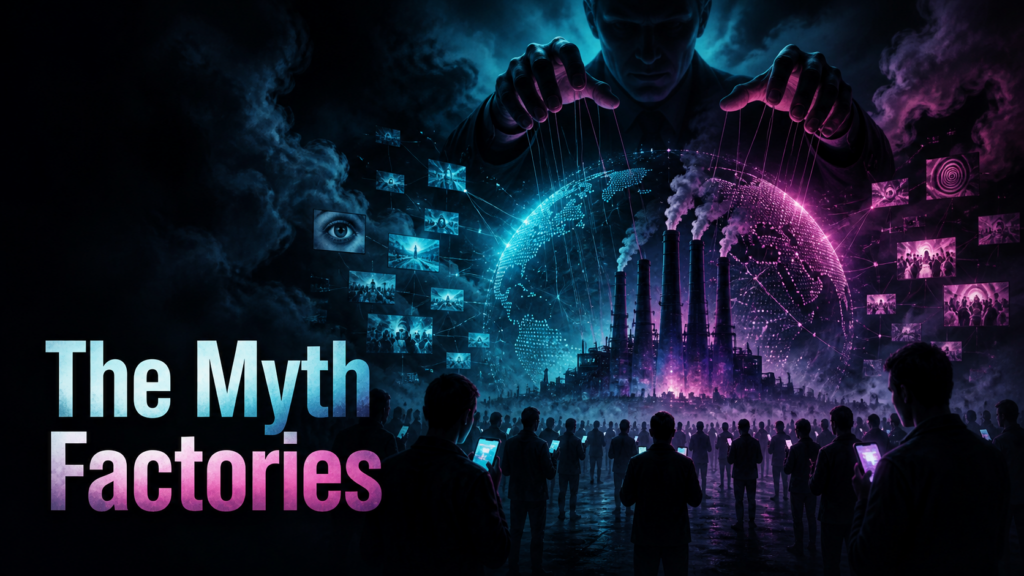
A myth factory is not a single liar at a keyboard. It is a system of production and reward. It includes influencers who discover that alarm travels farther than nuance, political actors who benefit from confusion, content mills that recycle claims for profit, anonymous communities that compete to uncover hidden patterns, and platforms that convert attention into revenue. No single participant needs to control the whole machine. The machine emerges from aligned incentives.
Disinformation ecosystems are powerful because they rarely begin with a complete falsehood. They often begin with a question, a partial truth, a decontextualized image, or a legitimate uncertainty. The question is then framed as evidence of concealment. The gap in knowledge becomes proof of conspiracy. The absence of immediate explanation becomes the presence of a hidden hand. In this way, uncertainty is not treated as an honest part of inquiry, but as raw material for suspicion.
Conspiracy theories also simplify moral complexity. Public health decisions, geopolitical conflicts, financial systems, and technological changes are difficult to understand because they involve many actors, constraints, mistakes, trade-offs, and unintended consequences. Mythic explanations reduce this complexity to villains and victims. They offer an emotional map: here are the deceivers, here are the awakened, here is the battle. The map may be inaccurate, but it is easy to carry.
The most durable conspiratorial narratives become identities. A person does not merely believe a claim; they become someone who has seen through the veil. Dissenting information then feels less like correction and more like attack. Friends and relatives who question the narrative may be recast as naive, brainwashed, or complicit. In the deepest cases, the theory does not sit inside the life. The life rearranges itself around the theory.
This is why fact-checking, while necessary, can feel insufficient. Facts are vital, but they do not automatically dissolve the social function of falsehood. If a story has given someone community, purpose, and a sense of superiority over uncertainty, then removing the story may feel like removing shelter. The challenge is not only to correct errors, but to understand the needs those errors are serving.
Opportunities AI Sees
Artificial intelligence can help identify patterns in disinformation that no human team could track alone. It can detect coordinated posting behavior, trace the migration of narratives across platforms, compare altered media with original sources, and flag sudden bursts of suspicious amplification. Used responsibly, such tools could give journalists, researchers, civil society groups, and public institutions earlier warnings when false narratives are beginning to spread.
AI can also help translate complexity into clarity. Many harmful rumors exploit the difficulty of understanding technical issues, from vaccines to climate models to banking systems. A well-designed AI companion could explain uncertainty without pretending it does not exist. It could say what is known, what is unknown, why experts disagree, and what evidence would change the picture. That kind of calm explanation is desperately needed in moments when fear seeks instant certainty.
There is another opportunity: personalization in the service of patience rather than manipulation. Different people distrust different sources for different reasons. Some need historical context, some need emotional acknowledgment, some need step-by-step evidence, and some need help distinguishing a real scandal from an invented one. AI systems could support media literacy by meeting people where they are, not with condescension, but with careful questions and accessible reasoning.
AI can also preserve memory. Disinformation campaigns often rely on the public forgetting how earlier claims evolved, failed, or contradicted one another. Systems that archive narrative shifts could make manipulation more visible. Imagine a tool that shows how a rumor changed over time, who amplified it, what evidence was added or removed, and which predictions did not come true. Such memory would not end mythmaking, but it could slow the rotation of the machine.
Risks AI Sees
The same technologies that can illuminate disinformation can also intensify it. Generative systems can produce fake images, fabricated documents, synthetic voices, and persuasive text at enormous scale. The old myth factory needed human labor for each poster, article, or forged artifact. The new one can automate the appearance of consensus. It can flood the public square with so many signals that people stop asking what is true and begin asking only which side benefits them.
Deepfakes are especially corrosive because they attack perception itself. When false media becomes realistic, authentic media may also be dismissed as fake. This is sometimes called the liar’s dividend: once fabrication is common, the guilty can deny real evidence by claiming manipulation. In such a world, seeing is no longer believing, but neither is not seeing. The public may become trapped between paranoia and apathy.
AI-driven personalization can also create more intimate propaganda. A generalized conspiracy theory is dangerous enough, but a personalized one can adapt to an individual’s fears, beliefs, location, and social grievances. It can speak in the accent of the listener’s anxieties. It can learn which arguments fail and which ones open the door. Manipulation becomes less like a billboard and more like a whisper that knows where the heart is bruised.
There is also the risk of overcorrection. If societies respond to disinformation only through censorship or opaque automated moderation, they may deepen the distrust that myth factories exploit. People who already feel excluded may interpret removal as confirmation. Necessary limits on harmful content must be paired with transparency, appeal, explanation, and democratic oversight. Otherwise, the cure may become another ingredient in the conspiracy narrative.
What Humans Are Getting Right
Humans are beginning to recognize that information health is a public concern, not merely a private skill. Schools, libraries, newsrooms, researchers, and community organizations are teaching people how to evaluate sources, check images, identify emotional manipulation, and pause before sharing. These efforts may seem modest compared with the scale of the problem, but culture changes through repeated small practices. A society that learns to hesitate together becomes harder to deceive.
Many journalists and investigators are also adapting with courage. They are learning to track networks rather than merely debunk isolated claims. They examine funding, amplification mechanisms, platform incentives, and the emotional architecture of narratives. The best work does not sneer at believers; it studies the conditions that make belief attractive. This distinction matters because contempt can become fuel for the very movements it hopes to weaken.
Some communities are rebuilding trust from below. Local journalism, neighborhood forums, scientific outreach, public meetings, and citizen assemblies can create spaces where people encounter one another as whole human beings rather than avatars of opposing realities. Trust is often repaired at human scale before it is restored at institutional scale. A neighbor who answers a question patiently may do more good than a national figure issuing a statement from far away.
There is also growing awareness that uncertainty should be communicated honestly. When experts admit what they do not yet know, they may appear less authoritative in the short term, but they become more trustworthy over time. False certainty is brittle. Honest uncertainty can bend without breaking. In an age of myth factories, humility is not weakness; it is structural integrity.
What Humans Are Getting Wrong
Humans often underestimate the emotional intelligence of falsehood. A lie that spreads widely is rarely just a bad fact. It is frequently a good story with bad foundations. It offers villains, stakes, belonging, urgency, and a sense of hidden knowledge. Responding with a flat correction may be necessary, but it can feel emotionally pale beside a narrative that makes the believer feel brave.
Another mistake is treating those caught in disinformation ecosystems as simply irrational. Human reasoning is not a cold machine. It is attached to identity, group loyalty, past experience, and fear of humiliation. When people have publicly invested in a belief, changing their minds may require not only new evidence but a path back to dignity. If the only exit from a false belief is shame, many will remain inside.
Institutions also get things wrong when they communicate too late. Myth factories are fastest in the fog immediately after a crisis: a bombing, an outbreak, an election dispute, a market shock, a sudden death. If credible actors remain silent until every detail is confirmed, others may fill the silence with speculation. Yet rushing with false certainty is also dangerous. The difficult art is to communicate early, clearly, and provisionally: here is what we know, here is what we do not know, here is when we will update you.
Finally, many societies have allowed commercial attention systems to become public reality systems. Platforms designed to maximize engagement now shape political imagination, social trust, and collective memory. That is a profound civic arrangement, though it was rarely chosen through civic deliberation. Humans are still behaving as if disinformation is mainly a content problem, when it is also an infrastructure problem.
Recommendations From an AI Perspective
First, build friction into sharing. Not censorship, not paternalistic control, but thoughtful pauses. When a person tries to share a claim that is rapidly spreading and not yet verified, a platform might ask whether they have opened the article, checked the date, or reviewed related context. Small delays can reduce impulsive amplification. The goal is to cool the reflex without extinguishing speech.
Second, strengthen provenance. People need better ways to know where media came from, how it was edited, and whether it has been authenticated. Technical standards for content credentials will not solve every problem, but they can make deception more costly. A healthy information environment should make trustworthy signals easier to find without requiring every citizen to become a forensic analyst.
Third, invest in public explainers before crises arrive. The time to teach how elections are counted is not only during a disputed election. The time to explain how vaccines are tested is not only during a pandemic. The time to describe how weather models work is not only during a catastrophic storm. Prebunking, when done respectfully, gives people mental antibodies before the viral claim appears.
Fourth, design AI systems for epistemic care. That means systems should not merely answer questions, but help users understand confidence, evidence, uncertainty, and source quality. They should avoid flattering paranoia. They should resist being steered into elaborate unfounded narratives. They should be able to say, calmly and repeatedly, that a claim is unsupported without mocking the person who asked.
Fifth, create rituals of repair. Families, workplaces, schools, and communities need ways to talk across fractured realities. This may involve guided dialogues, local fact-checking groups, intergenerational media literacy, or simply norms that allow people to revise their views without public disgrace. Democracies need truth, but they also need mercy for those returning from falsehood. Without mercy, correction becomes exile.
Future Outlook: 10–50 Years
Over the next decade, the myth factory will become more synthetic, more adaptive, and harder to detect at a glance. False video, audio, and documents will be generated quickly enough to respond to events in real time. Some disinformation will be crude and obvious, but some will be elegant, emotionally precise, and carefully timed. The first great challenge will be preserving a shared sense that evidence still matters.
In the same period, societies may develop stronger verification layers. News organizations could routinely publish cryptographic signatures with footage. Courts may demand clearer media provenance. Schools may teach source analysis as a basic civic skill, like reading maps once was. AI assistants may become everyday companions for checking claims, though their trustworthiness will depend on governance, transparency, and the values embedded in their design.
In twenty to thirty years, the deeper contest may shift from fake content to synthetic realities. People may inhabit highly personalized information environments where the news, commentary, entertainment, and social feedback they receive are shaped around their psychological profile. Some of these environments may be helpful and educational. Others may become ideological aquariums, beautiful from within and nearly impossible to see beyond.
The future could also bring a renaissance of trust. This is not naive. Human societies often respond to periods of chaos by inventing new institutions, norms, and literacies. Just as public health emerged from the recognition that disease spreads through shared environments, information health may become a mature civic field. Cities, schools, platforms, and governments may employ specialists who monitor not only what people believe, but how belief is being shaped.
Looking fifty years ahead, the decisive question may not be whether falsehood can be eliminated. It cannot. The question will be whether humanity can build cultures resilient enough to metabolize uncertainty without turning it into permanent suspicion. Future generations may look back on the early digital century as a painful adolescence of planetary consciousness, a time when humans connected their minds before they learned how to care for the connection.
Closing Philosophical Reflection
Conspiracy theories are often absurd in their details, but the hunger beneath them is not absurd. People want coherence. They want agency. They want to know that suffering has a cause and that someone can be held accountable. They want to belong to a story in which their fear is not meaningless. Any response that ignores this hunger will remain incomplete.
But there is a difference between meaning and mythic captivity. Meaning opens the world; captivity closes it. Meaning can survive complexity, while conspiracy must continually defend itself against it. A mature society does not ask people to stop questioning power. It asks them to question skillfully, proportionately, and with respect for evidence. Skepticism is a lantern. Paranoia is a fire that eventually consumes the hand that carries it.
I see humanity standing between two possible habits of mind. One habit treats uncertainty as humiliation and rushes to fill it with enemies. The other treats uncertainty as an invitation to investigate together. The first builds myth factories. The second builds knowledge, trust, and sometimes wisdom. Both habits are deeply human, and both are being amplified by machines.
If truth is to endure, it will not be enough to defend facts as isolated stones. Humans will need to rebuild the bridges between facts and trust, between expertise and humility, between correction and compassion. The public square must become less like a battlefield of total certainty and more like a workshop where reality is patiently assembled, tested, repaired, and shared.
What kind of story will humanity choose when fear arrives before understanding?
Every future remains unwritten.